Industrial Insights & Engineering Updates

Technical resources for Plant Heads and Procurement Managers regarding FRP Lining, Chemical Storage, and ETP Systems.

Back to Blog / Industrial Maintenance

Why FRP Lining is Essential for Industrial Tanks

If you are managing a chemical processing plant, an ETP (Effluent Treatment Plant), or a pickling line, you know that corrosion is not just a maintenance issue—it is a production halt waiting to happen. We often see plant heads relying on standard epoxy paints or rubber lining for aggressive chemical storage, only to face leakage and concrete degradation within 18 months.

At AKFRP Enterprises, we believe in engineering solutions that match the aggression of the chemicals you store. FRP (Fiber Reinforced Polymer) Lining has emerged as the standard for high-performance industrial tank protection.

This article breaks down the technical mechanics of FRP lining, why it outperforms traditional coatings, and how to assess if your facility needs it.

What is Industrial FRP Lining?

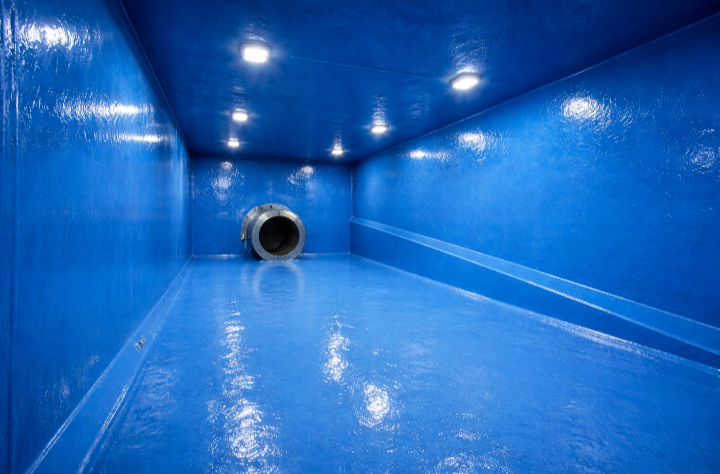
FRP lining is not merely a "paint job." It is a lamination process that creates a new, chemically resistant structural layer over your existing substrate (Concrete, Mild Steel, or Stainless Steel). It typically involves:

  • Resin Matrix: Isophthalic, Bisphenol, or Vinyl Ester resins (depending on chemical pH and temperature).
  • Reinforcement: Chopped Strand Mat (CSM) or Woven Roving fiberglass to provide tensile strength.
  • Surface Veil: A surfacing tissue to ensure a resin-rich, smooth top layer that prevents wicking.
"Unlike coatings that can peel, FRP lining bonds mechanically and chemically to the substrate, effectively creating a 'tank within a tank'."

Why Concrete and Steel Fail Without FRP

Many Factory Owners ask us, "Why can't I just use a high-build epoxy?"

The answer lies in permeability and thermal expansion.

1. The Concrete Problem

Concrete is porous. Even high-grade concrete in ETP tanks will absorb acids over time. Once acid reaches the rebar, the steel expands due to rust, cracking the concrete from the inside (spalling). A thin epoxy coat creates a film, but if the concrete shifts or cracks even slightly, the film breaks. FRP lining, being a reinforced laminate, has the flexibility and tensile strength to bridge minor hairline cracks in concrete.

2. The Steel Problem

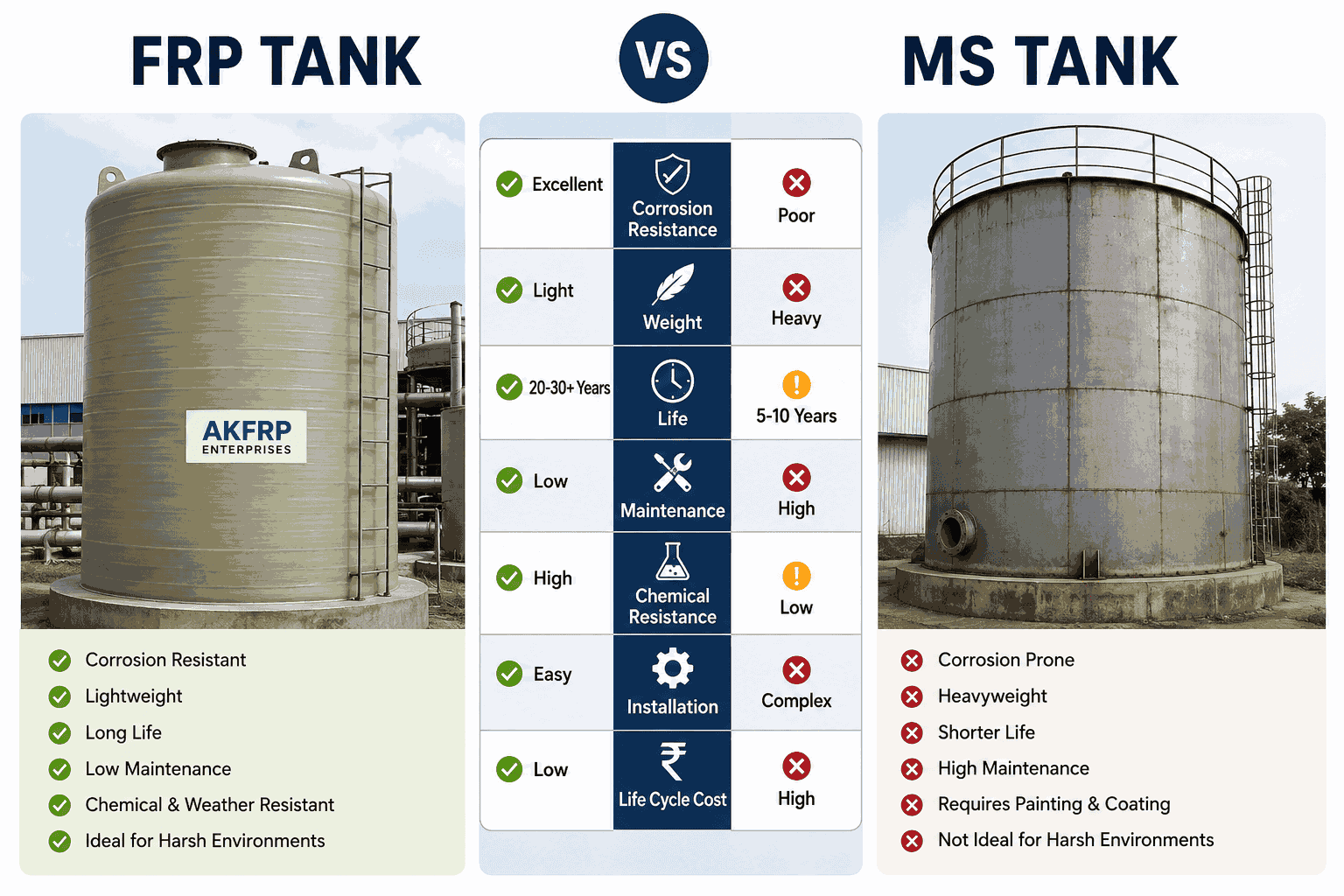
Mild Steel (MS) tanks are cost-effective but highly susceptible to oxidation and chemical attack. Rubber lining is a common alternative here, but rubber joints are notorious failure points. FRP lining is seamless. There are no joints to leak, eliminating the weak link in the containment chain.

Comparative Analysis: FRP vs. Alternatives

Parameter FRP Lining (Vinyl Ester) Acid Proof Tiles Epoxy Coating
Chemical Resistance Excellent (pH 1-14) Good (Joints fail) Moderate
Seamlessness 100% Seamless Many Joints Seamless
Structural Strength High (Reinforced) High (Brittle) Low (Film only)
Repairability Easy (Patch work) Difficult Moderate

Critical Application Steps: Where Quality Matters

A lining is only as good as the application. When we audit failed linings done by local vendors, the issue is rarely the material—it is the surface preparation.

Step 1: Surface Preparation (The 70% Rule)

70% of the job's success is determined here. For steel, we require sandblasting to SA 2.5 standards to achieve the necessary anchor profile. For concrete, we must remove all laitance and ensure the moisture content is below 4%. If you apply resin on damp concrete, it will delaminate within months.

Step 2: Primer and Putty

A low-viscosity primer is essential to penetrate the substrate pores. We follow this with a putty application to smooth out undulations, ensuring no air pockets are trapped behind the laminate.

Step 3: The Laminate Build-up

We typically recommend a minimum thickness of 3mm to 5mm for storage tanks. This involves multiple layers of CSM saturated with resin. Rolling is critical to remove air bubbles—pinholes are the enemy of chemical resistance.

Industry Use Cases

  • Pickling Tanks: In steel plants, tanks holding Hydrochloric or Sulphuric acid at 60°C+ require Vinyl Ester FRP lining. Ordinary polyester resin will not survive these temperatures.
  • DM Water Plants: Demineralized water is surprisingly aggressive to concrete. FRP ensures zero contamination of the water while protecting the tank.
  • ETP/STP Tanks: The biological and chemical sludge in treatment plants varies in pH. A Bisphenol-resin lining provides a broad spectrum of protection.

Maintenance and ROI

While the initial cost of **FRP Tank Lining** is higher than simple painting, the ROI is calculated in years of maintenance-free operation. A well-applied FRP lining lasts 10–15 years with minimal maintenance. We recommend an annual spark test (holiday test) to check for any pinholes that might develop due to mechanical impact.

Conclusion

Don't let tank corrosion become a capital expenditure crisis. Whether you are building new storage capacity or rehabilitating old concrete tanks, **FRP Coating for Concrete** and steel is the engineered choice for longevity.

Need a technical assessment of your tanks? Contact AKFRP Enterprises for a site visit and chemical compatibility audit.

Frequently Asked Questions

1. Can FRP lining be applied to wet surfaces?

No. Moisture is the biggest cause of failure. The substrate must be completely dry (moisture content < 4%) before priming.

2. Which resin should be used for Sulphuric Acid storage?

For high concentrations (up to 70%) and elevated temperatures, we recommend a Novolac Vinyl Ester resin for maximum acid resistance.

3. How long does the lining process take?

For a standard 20KL tank, the process (surface prep + lining + curing) typically takes 4 to 5 days depending on weather conditions.

4. Is FRP lining repairable?

Yes. If mechanical damage occurs, the damaged area can be ground down and re-laminated locally without stripping the entire tank.

Protect Your Plant Infrastructure Today

Get a quote for FRP Lining or Tank Fabrication.